
Excerpt from the Atlantic Jun 10, 2024
"The Most American City"
Searching for the nations future in Phoenix, Arizona
by George Packer | Photographs by Ashley Gilbertson
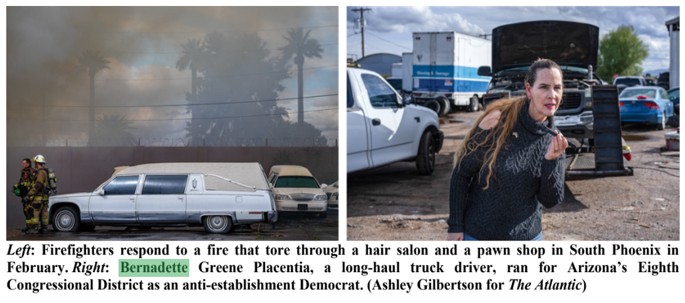
… The professional class has lost so much trust among low-income voters that a Democratic candidate has to be able to say: “I don’t despise you. I talk like you, I shop like you—I’m one of you.” This was the approach of Bernadette Greene Placentia.
She started working as a long-haul trucker in 1997, became the owner of a small trucking company, and at age 50 still drove one of the three rigs. She grew up in rural Nebraska and Wyoming, the daughter of a union railroader who was a conservative Democrat and National Rifle Association lifer—a type that now barely exists. She’s married to the son of a Mexican American labor leader who worked with Cesar Chavez, and together they raised an adopted daughter from China. She’s a pro-union, pro–death penalty, pro-choice gun owner—“New Deal instead of Green New Deal.” She struggles with medical bills and rig payments, and she was running for Congress as a Democrat in Arizona’s Eighth Congressional District, which encompasses the heavily Republican suburbs northwest of Phoenix.
The open seat in the Eighth was more likely to go to the Republican speaker of the Arizona House, Ben Toma; or to Blake Masters, the Peter Thiel disciple who lost his run for U.S. Senate in 2022; or to Anthony Kern, a state senator and indicted fake Trump elector who joined the mob outside the Capitol on January 6; or to Trump’s personal choice, Abe Hamadeh, another election denier who was still suing after losing the attorney-general race in 2022.
But I wanted to talk with Greene Placentia, because she confounded the fixed ideas that paralyze our minds with panic and boredom and deepen our national cognitive decline.
We met at a Denny’s next to the interstate in Goodyear. She was wearing an open-shoulder cable-knit turtleneck sweater with crossed American and Ukrainian flag pins. Her long hair was pulled back tight, and her eyes and mouth were also tight, maybe from driving 3.5 million miles around the country. As soon as I sat down, she said, “The Democratic Party purports to be the party of the working class. Bullshit.”
When she knocked on doors in her district and introduced herself, the residents couldn’t believe she was a Democrat. “We need to get rid of the political elites; we need to get rid of the multimillionaires,” she would tell them. “We need representative democracy. That means people like you and me.” And they would say, “Yeah, you’re not like the other Democrats.”
The image is a caricature, and unfair. The Republican Party is dominated by very rich men, including its leader. But populist resentments in America have usually been aroused more by cultural superiority than by great wealth. In 2016, Greene Placentia knew that Trump would win, because she worked every day with the targets of his appeal.
“As rich as that fucker is, he stood up there and said, ‘You know what? It’s not your fault; it’s their fault. They don’t care about you—I care about you. I will fight for you. They’re busy fighting to get guys in dresses.’ Crude, but that’s what he said. And when your life has fallen apart, when you’re not making shit, and somebody stands there and says, ‘I will help you. I believe in you,’ you’re gonna go there. We gotta belong to a pack. If that pack isn’t paying attention to us, you’re gonna go to another pack.” The pack, she said, is Trump’s, not the Republican Party’s, and its bond is so strong that a road-rage encounter between two members will end in apologies and bro hugs.
Bernadette Greene Placentia was trying to do for the Democrats what Sarah Palin had done for the Republicans.
For nearly a decade, journalists and academics have been trying to understand Trump’s hold on white Americans who don’t have a college degree. Racism, xenophobia, economic despair, moral collapse, entertainment value? Greene Placentia explained it this way: The white working class is sinking, while minority groups, with the support of Democrats, are rising—not as high, but getting closer. “When you’re falling and the party that built its back on you isn’t there, and you look over and they’re busy with everybody else and the environment and all this shit, and your life is falling apart, and all you see is them rising, it breeds resentment.”
She wasn’t justifying this attitude, and she despised Trump (“a con man”), but she was describing why she was running for Congress. “The reason they don’t listen to us—it isn’t because of the message we’re saying; it’s because of the messenger. They don’t trust any establishment Democrats. You’re gonna have to start getting people in there that they believe in and trust, and it has to be people that’s more like them and less like the Gavin Newsoms and the Gretchen Whitmers that grew up in the political world. Otherwise, every presidential election is gonna be on the margins.”
Stashed under her car’s dashboard was a pack of Pall Malls along with a “Black Lives Matter / Women’s Rights Are Human Rights / No Human Is Illegal …” leaflet. In a sense, Greene Placentia was trying to do for the Democrats what Sarah Palin had done for the Republicans. She was trying to make working-class into a political identity that could attract voters who seemed to belong to the other party or neither.
“The problem is, both the establishment Republicans and the establishment Democrats are gonna fight like hell against that person,” she said, “ cause that kind of person isn’t for a party; it’s for the people.”
The Democratic Party ignored Greene Placentia.
Paid for by Bernadette For Congress
info@bgp4az.com
If donating by mail, make checks payable to:
Bernadette For Congress
5156 W Olive Ave #202 Glendale AZ 85302
602-612-0678